
Energy management: for managing and optimizing the energy performance of your real estate
Energy Management: Key Practices and Issues
Energy Management is defined by a set of processes, management methods and actions put in place by organizations to improve their energy performance.
Our expertise and feedback allow us to respond in a targeted and effective way to the needs of real estate players in terms of Energy Management, by providing them with the necessary hindsight and expertise on the various strategic and operational facets of this key area of intervention:
Energy management can cover a variety of practices, and refers to key issues for managers and owners of real estate assets and assets.
The objectives of Energy Management are, in particular:
- Organize the technical and organizational monitoring of energy consumption and expenditure of an organization, a park, a real estate portfolio
- Control and reduce energy consumption
- Identify, arbitrate, and deploy action plans
- Ensuring energy reporting but also its counterpart, the carbon impact in operation
With the requirements of the DEET and the financial impacts of energy bills, as well as the necessary trajectories to reduce the carbon impact of buildings and the players who own and manage them, Energy Management has therefore become a central approach for many players.
In addition to the purposes of Energy Management, its modalities and implications, particularly methodological and organizational, deserve to be recalled and analyzed, particularly through the prism of our experience in the field.
Over time, TERAO’s dedicated teams have been confronted with different scenarios and different configurations of needs in this area, with organizations with various profiles, which have allowed us to forge a certain number of convictions, as well as to identify certain useful and valuable levers and pitfalls in this field.
Our experiences allow us to appreciate the extent to which:
- Data reporting platforms have become widespread and are extremely useful, even necessary, but they are not “magic tools”: they remain dependent on upstream and contextual factors (technical and organizational) and must be handled with hindsight and expertise, sometimes imposing a finer work of correlation and “dissecting” that passes, in fine, by handling Excel files, with great meticulousness and stubbornness;
- In practice, making the energy data relating to a fleet or a heritage reliable can be a challenge: within often heterogeneous assets, there are uses without meters, meters dedicated to entities, and meters common to several entities, etc., in short, many pitfalls at the source of the technical collection of real consumption data for all uses of real estate sites. This reality on the ground should not be ignored under any circumstances; it is necessary to take the trouble to verify it and avoid making mistakes in these steps;
- The key to success in Energy Management approaches lies in the “man-machine” interface, the ability to understand what can reasonably and statistically be automated and reliable information processing, and what should be provided by the contribution of expertise, as well as intelligence in the reading and analysis of data;
- From this point of view, the question of organization and expert human resources, analysis, and fieldwork interactions is quite central. Taking this organizational context into account is the real key to success in guiding efforts, organizing them and achieving results.
How TERAO intervenes in Energy Management
An iterative global approach
Energy management requires an iterative and dynamic approach. The tasks to be performed during energy management missions are often carried out iteratively rather than sequentially.
Each step dynamically contributes to the analysis, monitoring and reporting of performance, as well as the identification of sources of savings and the proposal of action plans.
The analysis work can be carried out at different levels, representative of the reality of the building stock concerned: geographical grids, by entity, activities and/or users, by type of building, by use, or by surface area. In collaboration with our clients’ teams, we set up the appropriate reporting tools and build the relevant monitoring performance indicators and ratios for their energy monitoring, carried out via interactive dashboards allowing data to be visualized by specific scopes, if necessary.
IPMVP reporting and performance monitoring (M&V)
Performance monitoring according to the IPMVP protocol
Energy consumption can (or even must!) be analysed by applying the principles of the International Protocol for the Measurement and Verification of Performance (IPMVP), developed and led by EVO. The IPMVP protocol is a set of guidelines for measuring and verifying the energy performance of buildings. It provides a framework for establishing performance baselines, measuring performance and verifying savings to facilitate the implementation of energy efficiency projects and the monitoring of performance over time.

The IPMVP protocol uses statistical methods to identify the data to which energy consumption is linked, to ensure that the right parameters are controlled to assess the energy performance of buildings. The baseline can be changed once the correct parameters are clearly identified and validated according to the IPMVP protocol. This baseline should be relevant to the parameters impacting energy consumption, but it should also be simple enough to be used as a powerful tool for monitoring energy performance by anyone concerned with the topic.
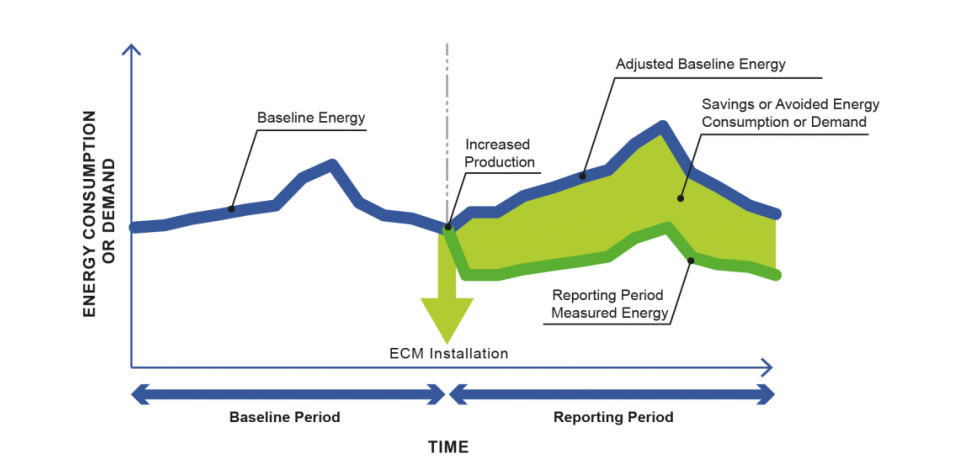
Principle of M&V according to the IPMVP protocol
In general, the IPMVP reference makes it possible to analyse energy performance and to reliably quantify the energy savings achieved. It makes it possible to predict energy consumption and detect energy drifts.
In concrete terms, our methodology matches the 3 factors that make up the variation in energy consumption:
- Changes in operating factors (periodic factors) that affect consumption, the most well-known of which is the UDI
- These influencing factors are not supposed to vary each year (static factors), the most important being the variation in scope (number of buildings, SDP) but also buildings closed for renovation, mergers/acquisitions, etc.
- The variation in consumption actual due to the action plans, which will be deducted both from the variations mentioned above and from the estimate of the expected gains from the action plans defined
Such analyses make it possible to represent actual consumption compared to what it would have been without an action plan.